Past
I got my bachelor of industrial design in 2024 at the Technical University of Eindhoven. Where I ended with the feeling that I still could learn more from the university. As I started my masters, I had already work for a research institute named Dune Works where I had worked on European projects about the energy transition. The role of the company was mainly to facilitate the intervention, collect feedback from the users and facilitate dialogue between the stakeholders and the other parties involved in the projects. I mainly helped with communicating and designing visuals. Which is in some ways similar to the project I had done during my bachelor where I worked on dealing with different stakeholders in the Huizona project. But with a bit more freedom and more designing. I continued to work on the topic of the energy transition, as my final bachelor project is on looking at energy consumption in the household and annotating it.
During my masters, I explored if it was the topic that I was interested in or the intangibility and abstraction of energy. I concluded that it is a bit of both as I found that I feel responsible to design for the broader topic of climate change. Additionally I find this topic interesting because climate change is inherently something that is hard to perceive. Climate change is incredibly complex, and I will not solve the whole problem with my designs. I think it is important to keep designing within the topic and to explore and nudge others to think about it differently. So for my research project I looked at sustainability and living alone. In this project I explored the practice of laundry and what sustainable laundry practices are. I got a bit lost in researching instead of also designing. This made me realize that in an individual project I needed to have more structure on how to document findings and have a plan
Within this project I discovered that some technologies could be more sustainable then others. But a big factor in how sustainable the laundry practice of a person was, is not necessarily the technology they used but the norms they adhere to. For example it is more sustainable to fully fill up a washing machine, which can be done by waiting or by washing with multiple people together. The question how to use technology and how to design it, was already in my vision during the bachelor. But in the master the question changed a bit as I also question whether technology was even the best solution. In Tilburg where I took courses from new media design, this crystallized more as I learned about the inequality that comes with digital technology. This leads to me exploring low-technology solutions in my FMP project.
Present
I started my FMP with three goals. First collecting and documenting what inspires me. This is a habit which I have develop in my bachelors and have kept up with ever since. Second managing stress by focusing on planning and time management. As I had heard that the FMP is stressful and the topic and things I wanted to do need time. Lastly prototyping and getting out of my comfort zone, to create a reactive prototype.
Within my FMP project, I combined several topics and theories I learned during my master’s. First, digital inequality and data colonization. After reading the paper on data colonization, my first thought was how I could implement it in design. Second, proximity and, to some extent, agency. In Emerging Technologies for Learning, the theory of proximity was discussed in the context of VR, and in Interactive Morality, the agency of things was explored. These ideas, combined with my memory of witnessing climate change, led me to the topic of climate change in the backyard. When I look at what inspired my design projects during my bachelor’s and at the start of my master’s, it was mainly art. Now, theories inspire me.
During this project, my planning and process had to change because I got sick. I was ill during the first week, and later I got sick again, which delayed prototyping and user testing. This was frustrating, as I had planned for delays in the process, but not for being sick for three weeks. In addition, contacting experts and receiving feedback happened differently than I had imagined. I had to make design choices I would not normally have made. However, I am proud of how I handled this. I was flexible and recognized that I needed extra time. Which is something I would not have done at the start of my master’s. This shows how my professional skills have developed, I can now step back from my own project as I do in group projects. I am more confident as a designer and professional, and I know what I am capable of and what I am not.
During this design process, I used more making techniques than before. My comfort zone is to sketch, create a paper prototype, and then build the final prototype. I still did this to some extent, but I also started with clay to physicalize my ideas and understand scale. This is something I learned from collaborating with other designers. For my FMP, I also set the goal of prototyping at a higher level to push myself out of my comfort zone. I achieved this. However, during the making process, I realized I was being too perfectionistic. I felt I could not start until every detail was figured out, which held me back. I experienced similar perfectionism in sketching and ideating at the start of my bachelor’s, which I overcame by doing and accepting that imperfect ideas have value. I applied this mindset toward the end of this project, but it is still something I need to work on.
So I will be looking at my development, by looking at the different expertise areas with in industrial design as well as all the courses I have taken whilst doing the master.
User & Society
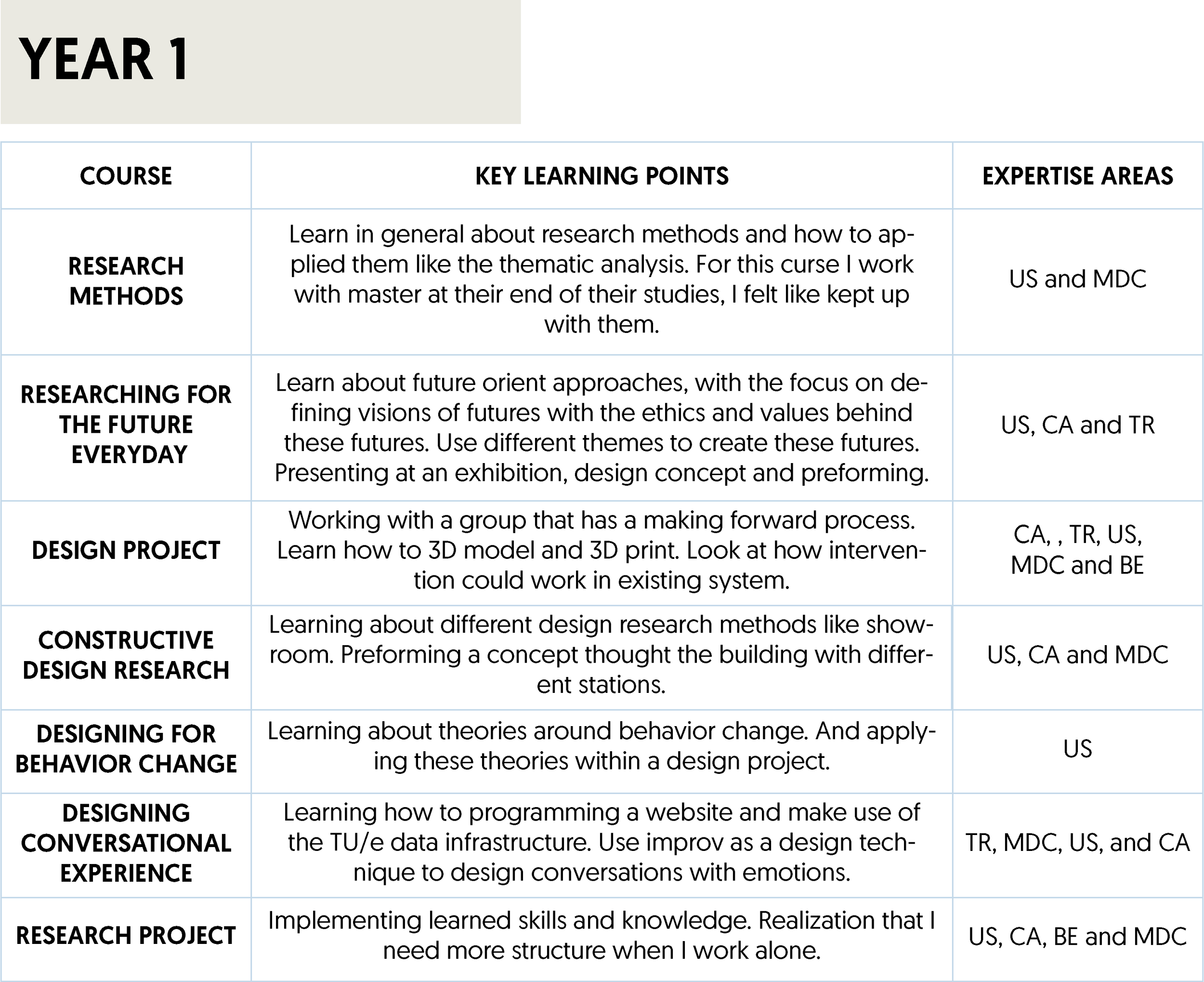
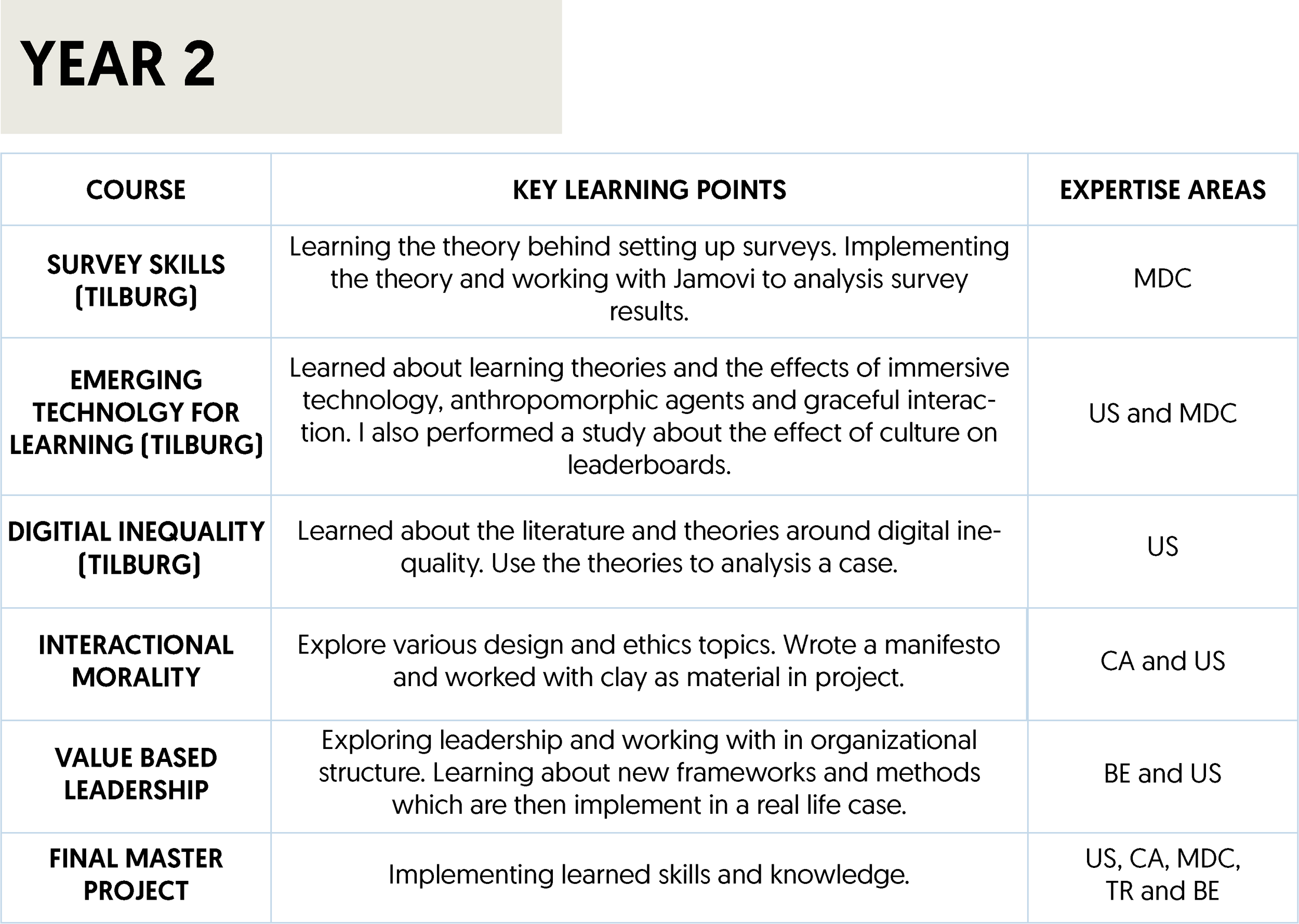
This expertise area is what differentiates designers from others, the focus on the user but also the bigger picture behind them in society. Throughout my masters, I have explored more theoretical knowledge. Like learning about the six main behavior theories in Designing for behavior change, and exploring the topic even more in Tilburg with the course Emerging technology for learning. Behavior change is needed for transitions and is closely linked with practices and cultural differences, which I explored in my research project. But for my FMP, I also looked at the non-human actors in the backyard and took a more-than-human approach.
During the master I have been getting more critical and creative on what kind of user studies I should do. The course research methods and in general all the user studies I have done through my masters have made me more critical on what I want to get out of a user study and what type of study might give the best results. The idea of provoking the user, with a showroom approach, to get richer data has stuck with me. As the exposition and performance I did, allowed for a different conversation than the standard user test with prototypes. This approach fits the climate change and transitions problems. I tried to take some of these elements with me into my FMP. As the idea of pheno data and the context of the backyard is quite provocative. The autoethnography, workshop and user test resulted in unique data, ideas and conversations.
Creativity & Aesthetics
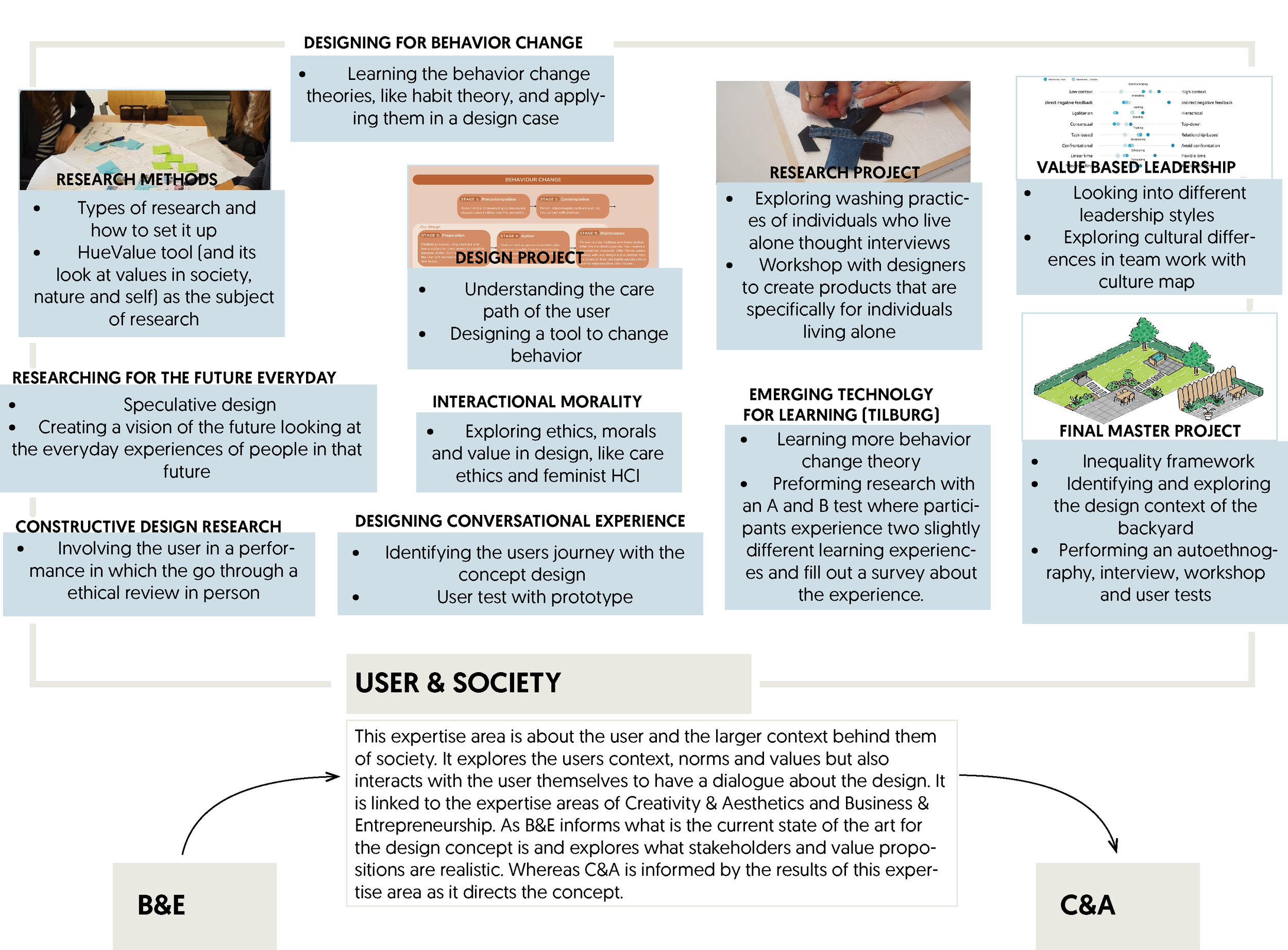
A big part of designing is being creative and coming up with new ideas. Throughout my masters I have widen my catalog of ideation methods. I am now more comfortable with ideation. As I am better at choosing appropriate methods. As for different projects different methods are better suited. Like the design project, which was for users with cardiovascular disease, meaning design cards with a theoretical base are better suited. Whereas in my FMP were I look at the entire backyard, a dioramic style helps to capture the situatedness of the concept.
I also explored the more physical ways of brainstorming like improvising and acting. But also making with materials and putting them at the forefront of the design process, such as the wood in my FMP and clay in my course. This new focus was a reaction to the prevalence of generative AI, which I am verry skeptical of. My design process was always started with sketching, but in my first design project I got pushed out of my comfort zone and learned a new way to ideate. For my FMP, I use making with clay as the starting point of iterating and then added more to the idea by sketching on top of the pictures of clay models.
Technology & Realization
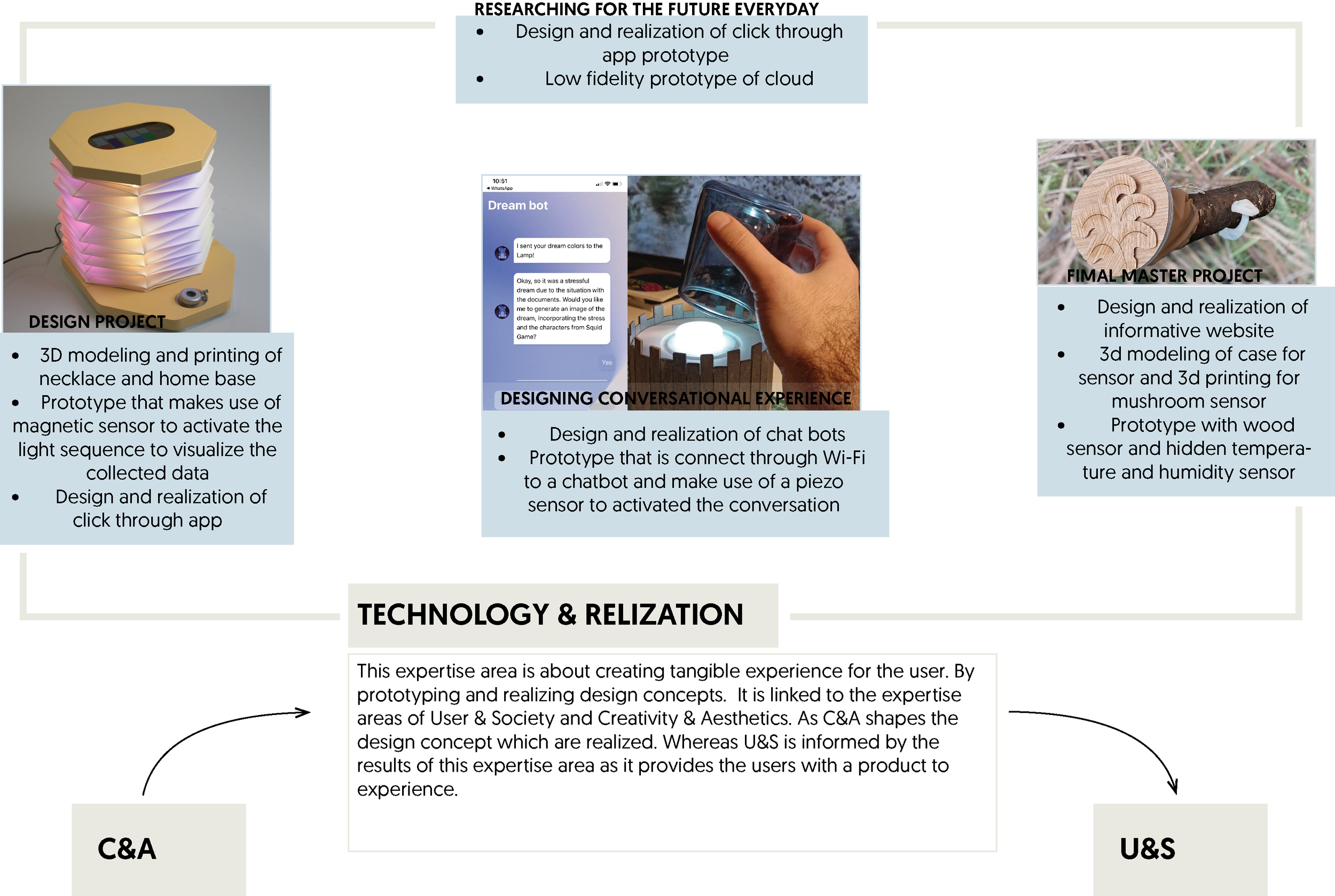
This expertise area focusses on realizing concepts and being able to experience these ideas. In this expertise area, I am hindered a bit by my perfectionism. However I still manage to make some working prototypes with integrated sensors. Like for my design project or the course designing conversational experiences. Where I also learn how to work with HTML and created a chat bot. I can see that my prototypes have gotten better aesthetically and technically, because of the new skills like 3D modelling and printing. But also through gaining an understanding of new tricks to cover imperfections. These new skills have helped me in my FMP as I was able to use the modeling for ideation and print the spines which help the wood sensor react to temperature.
Math, Data & Computing
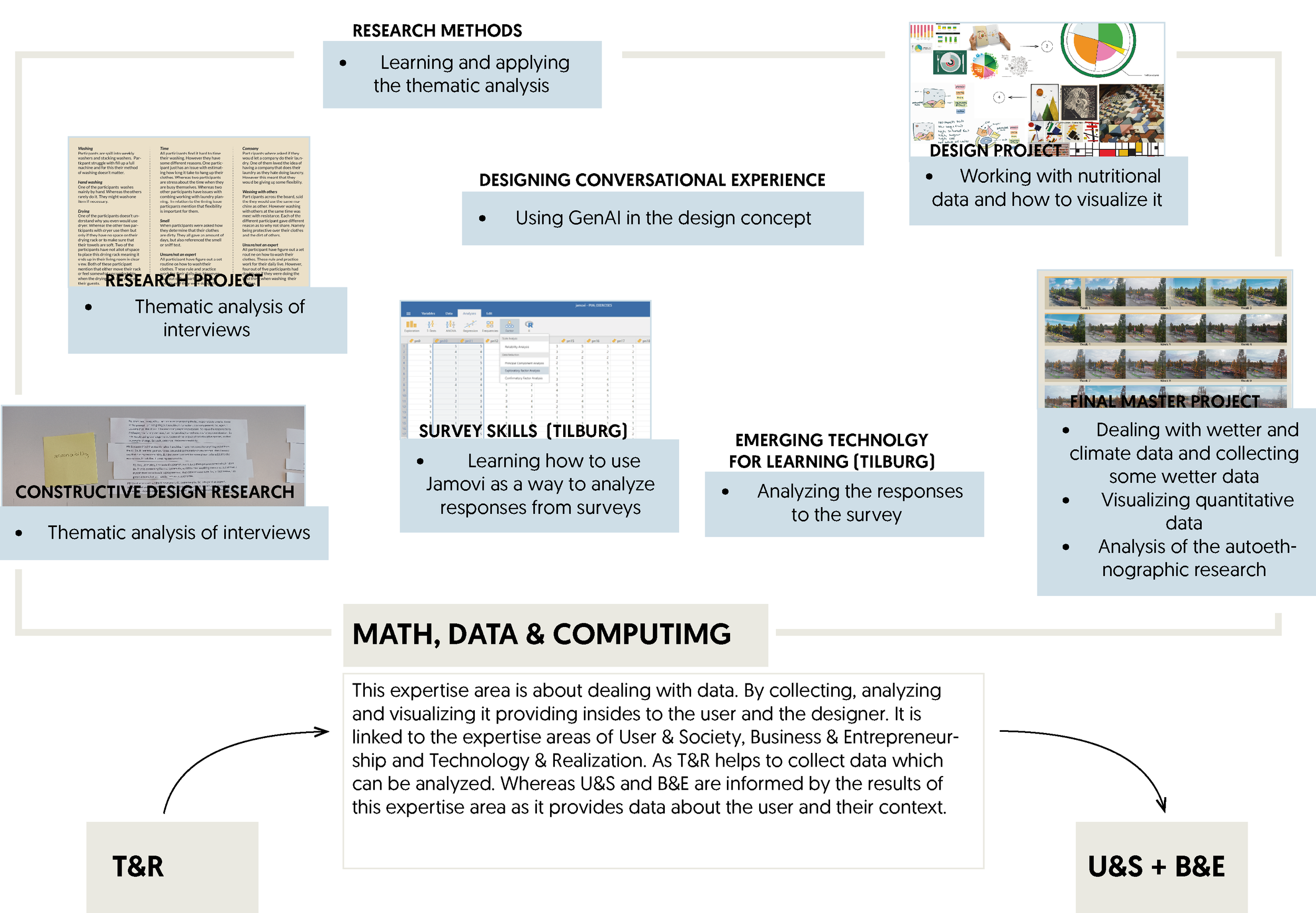
Designing for complex problems, brings complex data. Which needs to be deciphered and gathered. Throughout my master I have learned how to analyze this data in a more structured way and with more theoretical knowledge about the factors that I am testing. The structure comes from the course research methods, whereas the importance of theoretical knowledge got solidified in Tilburg. The course survey skill has taught me how to set-up as survey but also how to analyze the quantitative data. Which I got to implement in Emerging technology for learning. However in my design process, I mainly deal with qualitative data for which the thematic analysis is the most useful. For my FMP I also analyzed a lot of qualitative data from the interview, workshop and user tests. But my design was about how to communicate the quantitative wetter and climate data. I also explored the use of pheno data, as it provides a different perspective and deeper data. Which challenge me and my participants to think differently.
Business & Entrepreneurship
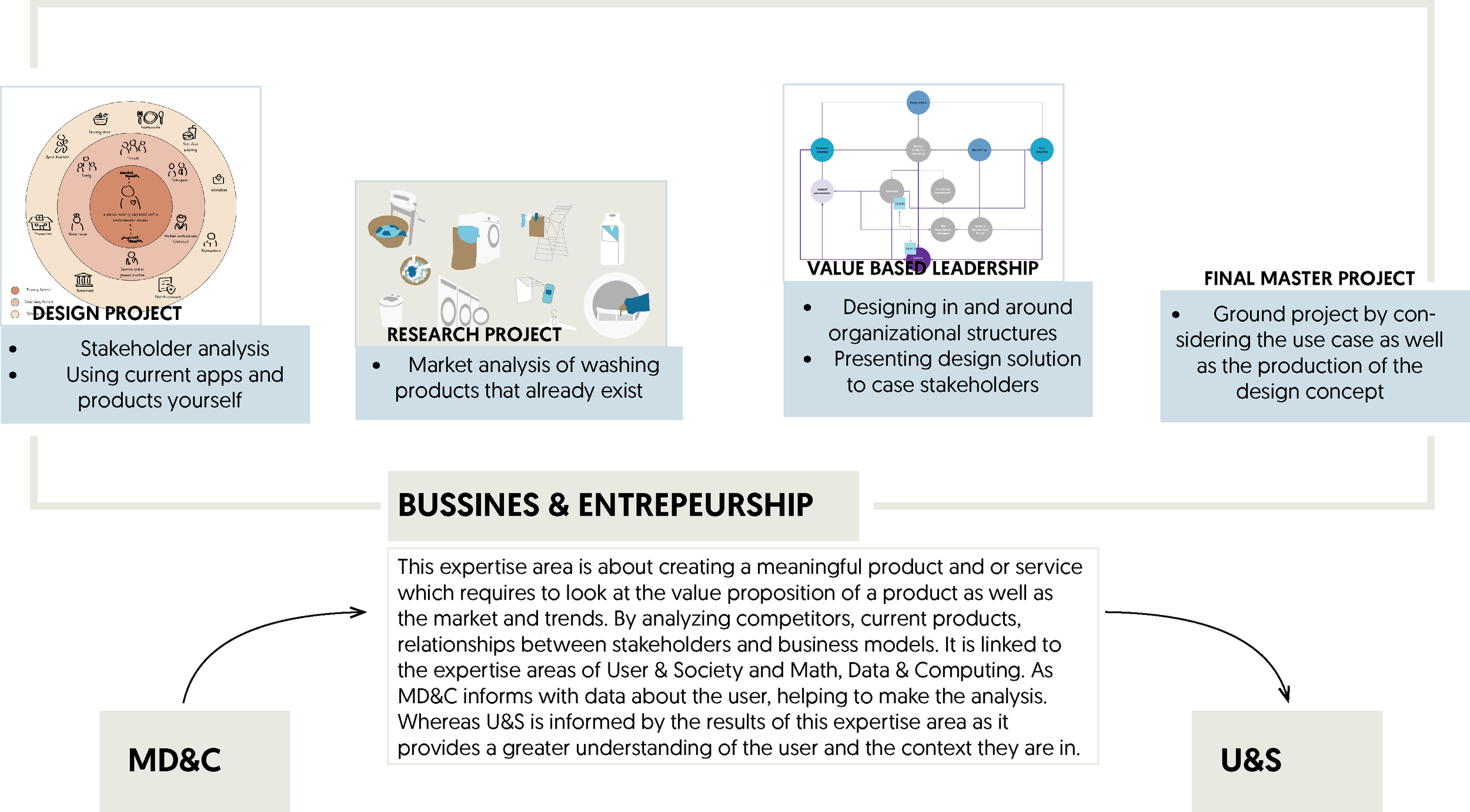
Creating a meaningful product and or service requires to look at the value proposition of a product as well as the market and trends. I learned in my bachelors that this expertise area provides me with interesting models and ways to analyze a situation. Like in the design project where the models and the testing of products are verry helpful to identify the most important stakeholders and what the user is missing and needing. During the course Value based leadership, I explored organizational models and got insight into how a bigger company works. Which will be useful for after my masters. In this course the styles of leadership were also explored and therefore your professional identity as well. Which helped me see that, I am not focused on how to sell the product that I am designing. Which leads to me looking at business and entrepreneurship as a starting point or after the design is completed. Like in my FMP, were my focus was on how to even see climate change and to find out what the design would be. The use case and production of the design was discussed at the end. This approach fits the transforming paradigm.
Future
At the start of the master I thought that I would never want to do a PhD, however after the first year this feeling changed. As I could imagine working for four years on research if I had the right topic. I still feel this way, however it is not clear what I would work on and I would have to work alone again.
After the last few courses I had, I realized that I was not really learning anything new. I did read some more interesting papers and got new perspectives but I already knew about the topic. Which is when I realized that I have gotten everything that I wanted from the university and I am ready to leave and get a job. I have already worked at a research and consultancy company and I see myself working at a similar company again. But I wanted be a bit more involved in shaping the projects not just to help facilitated.